A diagnosis was carried out by the technical staff of the forest, identifying that ash, white cedar, and pine trees showed the highest signs of bark beetle attacks, with varying degrees of damage, including standing dead trees.
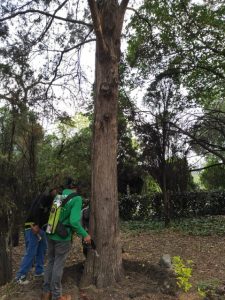
Intervention to address the phytosanitary problem was conducted through systemic plant endotherapy injections, aimed at contributing to the conservation and preservation of the forest.
The Endotherapy Process Includes:
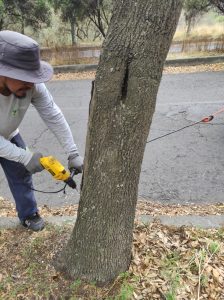
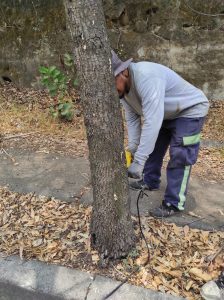
Drilling: Holes are drilled in each selected tree according to its circumference, using a ½ inch drill and a special wood bit (worm bit).
Insertion of Injection Valves: Special Injecthor valves are placed into the holes using a hammer. These valves contain a mechanism that allows the injected product to enter under high pressure while preventing backflow. They are made from biodegradable material derived from corn starch cultivated specifically for industrial use.
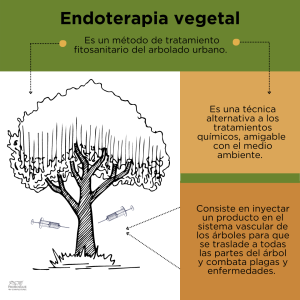
Injection of the Mixture: An application gun is placed on the Injecthor valves, connected to the Injecthor machine tank preloaded and pressurized to 80 psi. Each injection deposits 10–12 ml of the treatment mixture per the specified protocol.
Placement of Caps: After injections, plastic caps are placed over each valve to block the passage between the tree’s interior and exterior, preventing potential contamination while the tree’s natural compartmentalization (healing) process occurs.
Mode of Action: The active ingredients supplied to the trees are transported through the vascular system, producing a control effect on insects through contact and ingestion. Injected fungicides act on pathogens associated with these insects, suppressing them and leading to symptom remission in treated trees.
Plant endotherapy was considered the best treatment option due to its lack of chemical dispersion into the environment and its complete safety for humans and animals. The technique can be applied at any time of day and relies on the tree’s vascular system to move injected products from roots to the upper parts. The high-pressure injected products dissolve in the tree’s internal water and are translocated to all tissues, combating or repelling insect attacks and/or diseases caused by fungi or bacteria.
The process involves a comprehensive treatment of the forested areas, including monitoring, soil decompaction, and targeted irrigation of treated trees. A trapping system is also implemented to identify the types of insects or pests affecting the trees, enabling preventive and corrective actions.
These endotherapy treatments are carried out by Injecthor de México S. de R.L. de C.V.

 English
  Spanish